

Neither East nor West: Turkey’s Strategy for Survival

Note: The views expressed in this text are solely those of the author and do not necessarily reflect the position of this website.
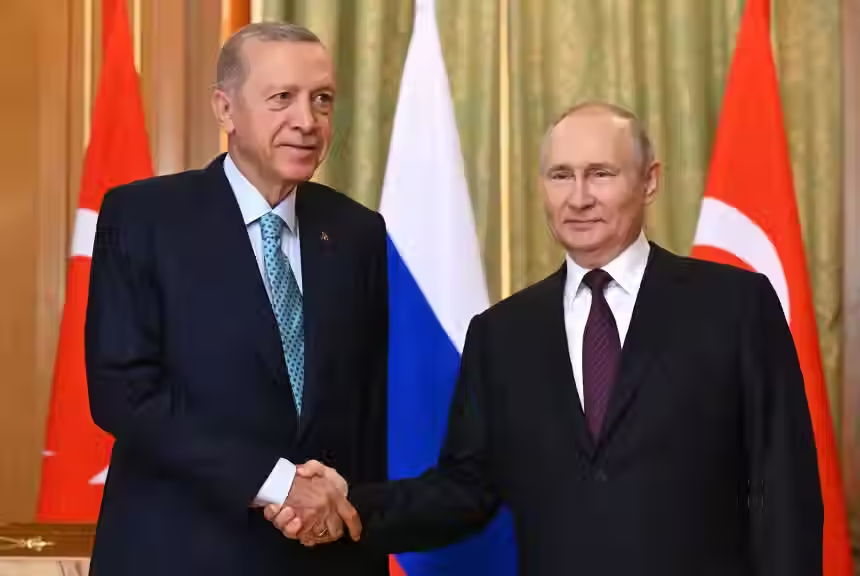
Over the past two decades, the perception that Turkey has been definitively distancing itself from the West while moving closer to Russia has become increasingly common. Since Recep Tayyip Erdoğan came to power, several developments have reinforced this narrative, including the deterioration of relations with the United States, the purchase of the Russian S-400 air defense system, the initial resistance to Finland’s and Sweden’s accession to NATO, and the intensification of economic and energy cooperation with Moscow. However, this interpretation oversimplifies a foreign policy characterized by pragmatism, as the rapprochement with Moscow constitutes a strategy aimed at expanding Turkey’s strategic autonomy and bargaining power in an increasingly multipolar international environment.
Erdoğan’s foreign policy has sought to reduce Turkey’s dependence on the United States and Europe while expanding its ability to negotiate simultaneously with different centers of power. Rather than accepting a subordinate position within NATO, Ankara has pursued a more independent foreign policy, capable of engaging simultaneously with Russia, China, Middle Eastern countries, and Western powers. The rapprochement with Moscow, therefore, serves as an instrument to increase Turkey’s bargaining power and expand its room for maneuver vis-à-vis the major powers.
This rapprochement with Russia was driven by concrete factors. The downing of a Russian fighter jet in 2015 marked a period of profound insecurity for Ankara, which had expected stronger support from its NATO allies in the face of the possibility of Russian military retaliation. At the same time, relations with Washington had deteriorated because of U.S. support for Kurdish militias in Syria, which Turkey considers an extension of the Kurdistan Workers’ Party (PKK), an organization designated as a terrorist group by the Turkish government. The perception of abandonment by Western allies was further reinforced following the attempted coup d’état in 2016, when Vladimir Putin was among the first international leaders to offer political support to Erdoğan, while the response of Western governments was perceived in Ankara as slow and hesitant. In this context, strengthening ties with Moscow became a rational alternative for reducing vulnerabilities and expanding Turkey’s strategic options.
The acquisition of the S-400 system symbolized this period of closer relations between Turkey and Russia. The purchase demonstrated Ankara’s intention to diversify its defense suppliers and assert its independence from the United States. However, this decision came at a significant cost. Turkey’s exclusion from the F-35 fighter jet program, the imposition of U.S. sanctions, and the deterioration of relations with NATO demonstrated that the pursuit of autonomy had concrete limits. Although Turkey’s defense industry is highly developed, it remains deeply integrated into Western supply chains, relying on components, financing, and technological cooperation primarily from the United States and Europe. As a result, the attempt to partially replace this dependence through partnership with Russia proved more costly than initially anticipated.
The worsening domestic economic crisis, characterized by high inflation, currency depreciation, declining international reserves, and a loss of investor confidence, made it clear that the country needed to rebuild its credibility with Western financial markets. The devastating earthquake of 2023 further exacerbated this situation by increasing the need for external investment and economic reconstruction. Consequently, foreign policy became influenced less by objectives of international projection and more by the need to stabilize the domestic economy. The appointment of Mehmet Şimşek to lead economic policy symbolized this process of re-engagement with international investors and the return to more orthodox macroeconomic policies.
Another important factor is the war between Russia and Ukraine. The conflict highlighted Turkey’s attempt to maintain an intermediate position between the two sides. Ankara condemned the Russian invasion, supplied military drones to Ukraine, and supported United Nations resolutions opposing Moscow’s aggression. At the same time, it refused to join the Western economic sanctions, preserving extensive trade relations with Russia and serving as an important economic channel for Moscow. This approach allowed Turkey to maintain its role as a mediator between the parties while safeguarding its economic interests. However, as the war dragged on, both U.S. pressure and the risk of secondary sanctions increased, making it economically more costly to sustain the same level of cooperation with Russia.
Changes in regional dynamics have also contributed to reducing the strategic importance of the Turkish-Russian partnership. Russia’s loss of influence in Syria following the fall of Bashar al-Assad’s regime significantly altered the regional balance of power. For years, Turkey had been compelled to negotiate continuously with Russia to protect its interests in Syrian territory. With the political transformation in Damascus, this dependence diminished considerably. At the same time, Ankara began to perceive greater opportunities for integration into European defense initiatives and military modernization programs led by NATO allies, reinforcing the incentives to restore closer relations with the West.
In conclusion, Turkish foreign policy continues to be guided by a logic of strategic survival. Rather than choosing definitively between East and West, Ankara seeks to preserve its freedom of action in an international environment characterized by competition among major powers. Its strategy does not consist of replacing one alignment with another, but of exploiting the opportunities offered by different centers of power to maximize its economic, military, and diplomatic interests. In this sense, Turkey remains less committed to ideological blocs than to preserving its autonomy and its capacity to adapt to the transformations of the international order.
Recommended reading:
Turkey: A modern history (Erik J. Zürcher)
Dispatch from Ankara: Turkey is establishing its own role in ‘NATO 3.0’ (Atlantic Council)


Comments